


Written and medically reviewed by Dr Majid Shah — GDC-registered (No. 195211), Birmingham.
TL;DR — Tear trough filler treatment is one of the most technically demanding under-eye treatments there is: placed well it softens a true under-eye hollow, placed badly it can make the area look worse. Who injects you matters more than almost anything else.
- The biggest safety factor: who’s holding the needle — a named, GDC-registered practitioner you can actually verify, not a brand name on a price list.
- Why it goes wrong: the wrong patient, the wrong technique, or too much product. The tear trough attracts water, so overfilling can leave the eyes looking puffy.
- Who it suits: a true under-eye hollow — not fluid retention or fat-pad puffiness, where hyaluronic acid filler can make things worse.
- Reversibility: it’s a hyaluronic acid filler, so it can be dissolved with hyaluronidase — a real medical step, not an instant undo.
- The risks, honestly: mostly swelling and bruising, and serious complications are rare. Vision-related problems are extremely rare but, if they happen, can be irreversible.
Table of Contents
ToggleSomething I get asked constantly is, what is tear trough filler? In short, it’s a hyaluronic acid gel that adds a small amount of volume to the hollow between the lower eyelid and the cheek — also called under-eye filler.
Placed well, it softens the under-eye shadow that makes you look tired. Placed badly, it’s one of the harder treatments on the face to get right — and that’s the part most pages skip.
So before anything else, here’s how it goes wrong, and how to make sure it doesn’t.
Why does tear trough filler go wrong?
The honest answer is that most poor tear trough results aren’t bad luck. They come down to one of three things: the wrong patient, the wrong technique, or too much product.
This is one of the most technically demanding areas on the face to inject. The skin is thin, the anatomy underneath is fiddly, and the gap between “a bit better” and “noticeably worse” is small.
I’d be cautious about anyone presenting it as a quick, routine job.
When the patient isn’t suitable
Not everyone with tired-looking eyes is a good candidate. Plenty of under-eye shadows aren’t a hollow at all — and filler in the wrong situation can make the area look worse, not better.
Getting this judgement right before anyone picks up a needle is half the treatment. (More on exactly who it suits further down.)
When the technique or filler amount is wrong
The tear trough attracts water. So if you overfill it, the filler pulls in fluid and the eyes end up looking puffy — the opposite of what you came in for.
The other common error is placing filler too superficially in that thin under-eye skin. There it can show through as a faint bluish or blue-grey tint — the Tyndall effect.
In pooled data that shows up in around 1% of cases, with one single-clinic series closer to 3%. It varies by technique.
Careful placement depth is largely what prevents it — which is why I keep coming back to it.
Why does who injects your tear trough filler matter?
If you take one thing from this page, make it this: with this treatment, who holds the needle matters more than almost anything else.
Credentials and training to look for
That person, here, is me — Dr Majid Shah, registered with the General Dental Council. You don’t have to take that on trust; you can look the number up yourself on the GDC register.
When you’re choosing anyone for under-eye work, that’s the baseline I’d want you to check first: a named, registered practitioner you can actually verify, not a brand name on a price list.
A conservative, safety-first approach
My approach to this area is deliberately conservative. I’d rather under-treat than overfill — build the area up gradually over months, and longer if needed, than go in hard and have a patient regret it later.
With the under-eye especially, going too aggressively is something you can end up wanting to dissolve, and I’d rather we never get there.
Before treating, I do a proper assessment of the concern itself — whether it’s a true hollow, how long it’s been there, and how it’s affecting you.
Alongside that I look at lifestyle factors like hydration, salt intake and any allergies, because those change what’s actually going on under the eye. It’s not a filler-only conversation.
Think about it over a ten-year horizon, not a ten-day one. The patients who do best are the ones treated steadily and honestly, not the ones chasing the biggest change in one sitting.
Cristina Olsen
3 months ago
Lovely experience from start to finish. Tear trough treatment was explained clearly and I felt in safe hands. Subtle improvement and I look much less tired. 5*
Tara S
2 months ago
Upon doing a lot of research, it kept leading me to Dr Shah. His ability to keep anxious first-time patients calm is impeccable, and his knowledge and advice is thorough. He is not pushy and makes you feel in good hands. I experienced zero bruising and can only put that down to his technique. 10 out of 10.
Hanna Havon
1 year ago
Amazing quality and advice. Really patient and takes time in treatments. By far the most consistently great treatments I've had over the years. Wouldn't trust anyone else with my tweakments now!
What are the risks and side effects of tear trough filler?
I’m not going to soften this section, because the whole point of choosing carefully is to manage real risk.
Most tear trough treatments pass without a problem — in one study, around 82% of patients had no complication after their first treatment. And the chance of a problem rises the more filler is used.
But “most” isn’t “all,” so here’s the honest picture.
Common and rare complications
Some swelling is the most common after-effect, reported in roughly 10–19% of cases. It can take a while to settle.
Bruising doesn’t happen every time, but you should expect the possibility — usually small blue dots that take about a week to fade.
Lumps or nodules can form, sometimes weeks or months later. Contour irregularities sit at around 5% in pooled data; delayed nodules are less common and tend to resolve, and the rate varies by product.
I won’t tell you one filler is “safer” than another — that’s not a claim I can stand behind.
Infection is rare but possible. Watch for burning, redness, swelling and tenderness around two to three days afterwards, which can need antibiotics.
Filler can also move from where it was placed, or last longer than expected — occasionally years. Sometimes it settles in a way that looks like under-eye bags.
The serious one is rare, but I’d never pretend it can’t happen: very occasionally filler can enter a blood vessel and affect the eye, which can cause vision loss.
This is extremely rare, but if it happens it can be irreversible.
The tear trough is a lower-risk site for this than the nose or forehead — but it isn’t zero, and that’s exactly why technique and anatomy knowledge matter.
A simple rule on warning signs. Sudden vision change, severe or escalating pain, or skin going pale, white or dusky → treat that as urgent and get emergency care.
Lumpiness or swelling that lasts → contact your practitioner, or your GP if it needs medical care.
(Side effects from a treatment like this can also be reported in the UK through the MHRA Yellow Card scheme.)
Can tear trough filler be dissolved?
Because the filler I use here is hyaluronic acid, it can be dissolved with an enzyme called hyaluronidase. The dissolving itself takes around half an hour, with the effect starting within the hour and taking up to seven days to fully come through.
I’m telling you that as a fact, not as a safety net. I never want a patient walking in thinking “if I don’t like it, they’ll just undo it.”
Dissolving is a real medical step with its own considerations, not an instant reset. The better plan is to not over-treat in the first place.
Who is tear trough filler suitable for?
Here’s the feeling that brings most people to this treatment: you look exhausted when you’re not.
You’re sleeping fine, you feel well, and the mirror still says otherwise.
That under-eye hollowing is part of how the area changes over time, as volume is naturally lost around the eye socket. It’s biology, and it has very little to do with how tired you actually are.
When you look tired but aren’t
If that’s you, you’re in the right place to at least ask the question. But “I look tired” is the start of the conversation, not the answer to it.
Who it suits, and who it doesn’t
Filler suits a true under-eye hollow — genuine loss of volume in that groove. It does not suit everyone whose under-eye looks shadowed.
If the issue is fluid retention, or fat pads that have shifted forward (the puffiness some people get), filler is the wrong tool. And because filler attracts water, putting it where it isn’t needed can make the area look worse.
Those are patients I turn away, and sometimes refer to a blepharoplasty surgeon to assess the under-eye fat pads properly.
I know turning someone away isn’t the usual sales move. I see it the other way round: being told “this isn’t right for you” is the strongest safety signal a clinic can give you.
What happens during a tear trough filler appointment?
Let me break down what actually happens, because knowing the steps takes a lot of the nervousness out of it.
It starts with the assessment above — what the under-eye actually needs, and whether filler is the right answer at all.
If it is, I choose from several hyaluronic acid fillers (such as Teosyal, Juvéderm or Restylane) to match your skin type and the depth we’re treating. I’m not tied to one brand, because the patient comes first, not the product.
Needle or cannula?
This is decided case by case, by which parts of the tear trough and which depths need treating — not by a fixed rule, and not because one is “the safest.”
A cannula is effectively a single entry point and is blunt, so it parts the tissue rather than cutting through it. That tends to be less painful, if slightly odd-feeling.
A needle suits other situations. The right choice is whichever fits your anatomy on the day.
How much product you’ll need
This genuinely varies, and I’d be cautious of anyone quoting you a fixed amount before they’ve looked at you.
It depends on your anatomy and what the assessment shows. And given everything above about overfilling, “less, reviewed and built up” is usually the safer path than “more, in one go.”
Does tear trough filler hurt?
It can be slightly uncomfortable, but numbing cream helps a lot. With a cannula it’s effectively one injection at the entry point.
On the day itself, we go through a consent form covering the risks, you complete a medical-history form, I answer your questions, and we both sign the consent form.
Then numbing cream goes on, and the treatment itself happens about ten minutes later, once the numbing has had time to work.
What results can you expect from tear trough filler?
I’d rather show you honest examples than make promises, so the gallery here is real, consented patient images. Results vary from person to person, because every under-eye is different.
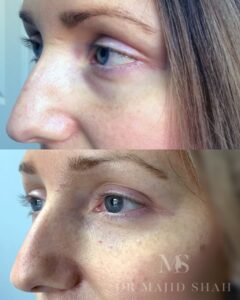
How soon you’ll see a difference
You may notice a change quite quickly, but the early days aren’t the true result — swelling can mask it.
Visible swelling typically settles within about four to five days, and it can take roughly two weeks for the deeper, not-visible swelling to settle and the final result to show.
So I’d ask you to judge the outcome at two weeks, not on day one.
The practical details
How long does tear trough filler last?
In my experience, most patients need a top-up around 6 months after the first visit, then maintenance falls anywhere between 9 and 36 months depending on how fast you metabolise the product. Some patients burn through it quickly; others hold onto it very well.
That first 6-month mark is part of building the area up gradually rather than chasing one long-lasting hit — the early treatment beds in, and we review from there.
What drives the difference is your own metabolism, how much was placed, where, and the filler chosen for you. Treat any duration as a typical range, never a guarantee.
How do you care for tear trough filler after treatment?
Plan around the possibility of bruising — I’d avoid any big event for at least a week, since bruises take roughly that long to fade and can be hard to cover.
Keep makeup off the injection sites while they settle, because of the infection risk.
As above, visible swelling tends to settle in four to five days, with the deeper swelling taking around two weeks. During that window you may temporarily lose a little of the result before it settles back.
None of that is a complication; it’s normal settling.
How much does tear trough filler cost?
Tear trough filler costs £500 for 1ml at this clinic. That’s the price for the product; the right amount for you comes from the consultation, not from a page.
What affects it is what the assessment shows — how much product is appropriate and the plan we set, rather than a one-size figure. I’d be wary of any under-eye price quoted before anyone has assessed your anatomy.
The bottom line on tear trough filler
Tear trough filler works for a true under-eye hollow — not fluid retention or fat-pad puffiness, where it can make things worse.
The single biggest safety factor is who injects you: a named, GDC-registered practitioner you can verify, not a brand on a price list. It’s hyaluronic acid, so it’s reversible with hyaluronidase, though dissolving is a real medical step, not an undo button.
Serious complications are rare and vision-related problems extremely rare — but possible — which is exactly why technique and assessment matter more than price.
Booking a tear trough consultation
A consultation here is first and foremost a suitability and safety check. It’s where we work out whether filler is even the right answer for your under-eye — and where I’d tell you plainly if it isn’t.
There’s no pressure to book treatment on the day. I’d actively rather you took the time to get every factor right than rushed it before an event.
Book a tear trough consultation with Dr Shah — that conversation is the sensible first step.