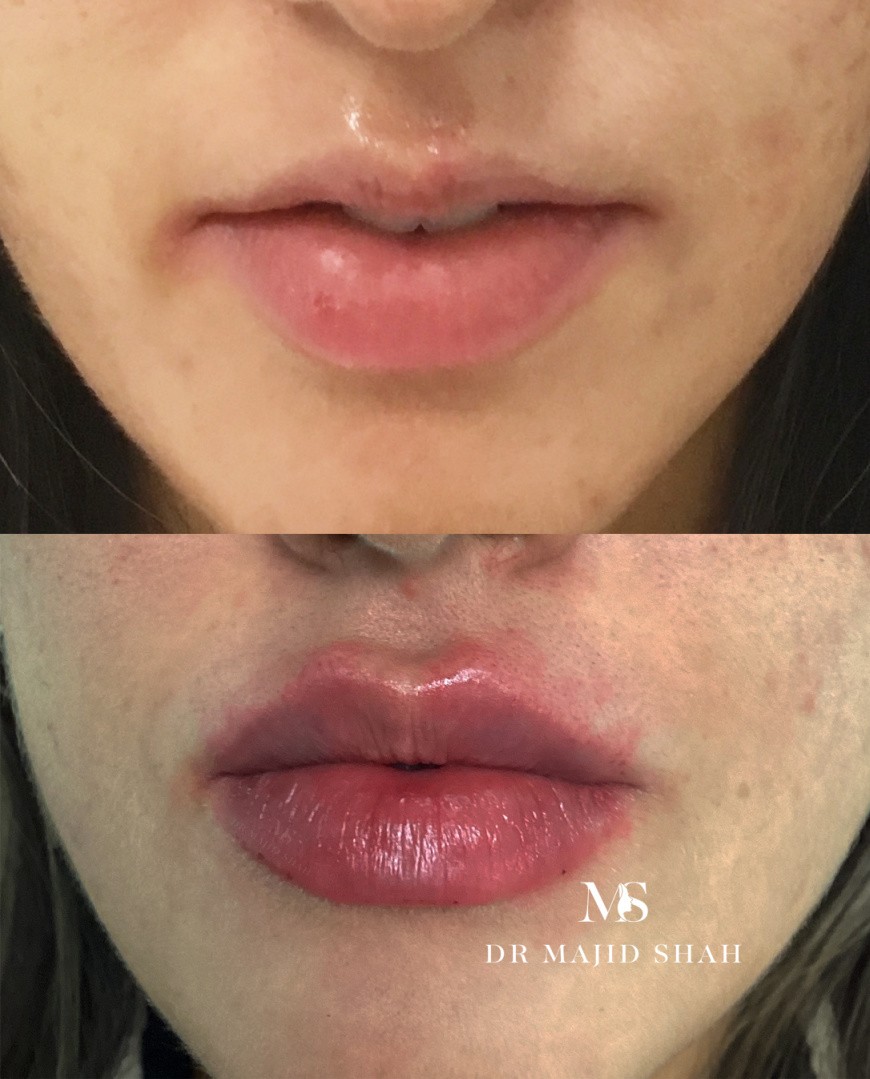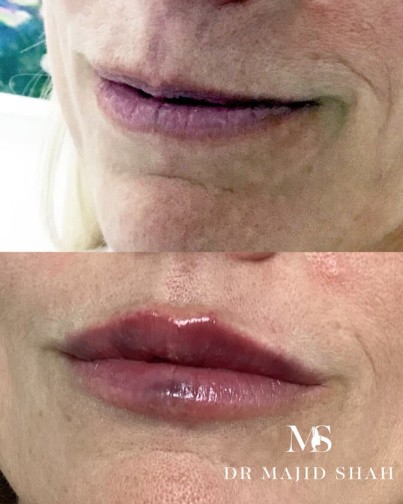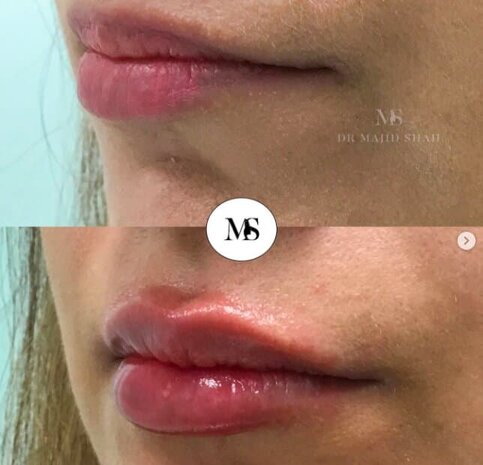

Thinking about lip enhancement is a big decision, and the problem is that there is a lot of noise around it.
Some of it makes it sound very simple. Some of it makes every treatment sound amazing. In reality, it is a bit more nuanced than that.
The honest answer is that lip enhancement can work very well, but only when the treatment suits the person, the goal is realistic, and the result is approached with a bit of restraint.
This guide explains the main lip enhancement options available in the UK, what tends to look natural, the difference between temporary and permanent treatments, and what to look for when choosing a qualified practitioner.
Written and reviewed by Dr Majid Shah (GDC No. 195211).
Surgical vs Non-Surgical Lip Enhancement
Something people get stuck on quite quickly is whether they need something surgical or non-surgical.
The honest answer is that most people do not need to jump straight to surgery.
If I was to give a general answer, I would say non-surgical treatment is usually the more sensible place to start because it is less commitment, less downtime, and gives you far more control over the result.
Non-surgical lip enhancement usually means hyaluronic acid filler. This is the most common option in the UK for a reason.
It is quick, adjustable, and when it is done properly, it can look very natural.
It can be used to add shape, improve border definition, restore hydration, and create more fullness without surgery.
It also has one big advantage that permanent treatments do not: if needed, it can be adjusted or dissolved.
Surgical lip enhancement is a different category altogether. It is more invasive, more permanent, and usually comes with more recovery and more risk.
That might include lip implants, fat grafting, or a lip lift. For some patients, that may be appropriate. But for many, it is too much too soon.
That is really the key difference. Filler gives you room to refine. Surgery gives you permanence, but with that comes less flexibility.
For treatment-focused information, visit my lip fillers Birmingham page.
What Makes Lip Enhancement Look Natural?
This is probably the part people care about most, even if they do not always phrase it that way.
Most patients are not really asking for “big lips.” What they are usually asking for is lips that look better, fresher, more balanced, or a bit more defined. That is a different thing entirely.
In my experience, natural-looking lip enhancement is less about volume and more about proportion, shape, and restraint.
Once people get too focused on size alone, that is usually where things start to go wrong.
This applies to both women and men, and if you want a more focused guide, you can read our page on lip fillers for men.
Proportion
There is no single formula that suits everybody, and I would be cautious about anyone presenting lip aesthetics as a fixed rule.
Yes, there are proportions people talk about, and in some faces they matter.
But real treatment planning is more individual than that.
Lip length, existing volume, lip movement, and the relationship between the upper and lower lip all matter.
A subtle enhancement on the right anatomy can look excellent. The same volume in somebody else can look too much very quickly.
Harmony
The lips do not exist on their own. They have to make sense with the rest of the face.
That includes profile, chin position, the nose, the teeth, the way the mouth moves, and the patient’s natural facial structure.
Sometimes a treatment looks “unnatural” not because the filler itself was excessive, but because the lips were treated in isolation without enough attention to the rest of the face.
That is why the best results often do not look like obvious filler. They just look better balanced.
The long-term view matters
This is the bit people do not always think about enough.
It is easy to focus on how the lips will look next week. A better question is whether you will still like the result in a year or two, or whether you will look back and feel it was overdone.
If the plan is sensible, the result tends to age better. If the plan is just “more volume,” that is where regret can creep in.
Temporary vs Permanent Lip Enhancement
This is another distinction that matters more than people think.
Most lip fillers used in the UK are temporary. That is not a weakness. In a lot of cases, it is actually the reason they are the better option.
Temporary filler gives you flexibility. It allows the lips to be adjusted over time, reviewed properly, and changed if your preferences change.
For many patients, that is a very good thing because what sounds appealing at the start is not always what still feels right later on.
Permanent lip enhancement usually means surgery, such as implants or fat transfer. There may be a place for that, but it is a bigger step.
It comes with more commitment, and it is not something I think people should rush into just because they want a longer-lasting result.
The honest answer is that temporary treatment is often the wiser starting point.
You can always build cautiously. It is much harder to undo a permanent decision you regret.
For a more detailed breakdown, read our guide to temporary vs permanent fillers.
Russian Lip Technique Explained
Russian Lip is probably one of the most talked-about lip filler styles, and it is also one of the most misunderstood.
The short version is that it is a technique designed to create more lift and height through the lip rather than simply pushing the lips forwards.
In the right patient, it can create a very defined look. In the wrong patient, or done badly, it can look quite obvious.
So is it a good technique? Sometimes, yes. But I would not treat it like a fixed style that suits everybody, because it does not.
Some faces can carry it well. Others cannot. That is where proper assessment matters more than trends.
If you want a more detailed explanation, read the full guide to the Russian Lip Technique.
Risks and Safety Considerations
Lip enhancement is often spoken about as though it is just a beauty treatment. It is not. It is a medical treatment, and it needs to be approached like one.
That does not mean people should be frightened of it. But it does mean they should be realistic.
With filler, common side effects include swelling, bruising, tenderness, and temporary unevenness while the product settles.
Those things are fairly normal. More serious complications are uncommon, but they do exist. That is exactly why practitioner choice matters so much.
Surgical treatments carry their own risks too, including longer recovery, scarring, and the possibility of a result that is not easy to revise.
The main point is this: safety is not just about the product. It is about who is assessing you, who is treating you, and whether they know what to do if something is not right.
Choosing a Qualified Practitioner in the UK
This is probably the most important decision in the whole process.
There are plenty of people offering lip treatment in the UK, but not all of them have the same medical background, anatomical knowledge, or ability to manage complications. That is just the reality of it.
So let me break down what I would actually look for.
First, check their medical registration. A doctor, dentist, or nurse prescriber with proper training in facial aesthetics is a much safer place to start than somebody with very limited medical grounding.
Second, look at their results properly. Not just one polished before and after.
Look at the overall pattern. Do the lips look balanced? Do they suit the face? Do they look like real treatment outcomes rather than heavily selected examples?
Third, pay attention to how they communicate. A proper consultation should not feel rushed.
It should cover your medical history, your goals, the risks, the likely limitations, and whether treatment is actually appropriate.
Sometimes the right answer is a conservative plan. Sometimes it is to wait. Sometimes it is not to treat at all.
And lastly, make sure they are properly insured and know how to recognise and manage complications. That should not be optional.
The honest answer is that good treatment is not just about who can inject.
It is about who can assess properly, say no when needed, and think beyond the appointment itself.
If you are new to treatment, you can also read 17 tips to know before first-time lip fillers.
About the Author

Dr Majid Shah is the founder of Dr Majid Shah Aesthetics.
He trained at King’s College London, where he was awarded an Award of Merit for Practical Excellence, and has continued his training in advanced facial aesthetics.
Dr Shah has performed over 4,500 non-surgical treatments and focuses on natural-looking results, careful treatment planning, and patient safety.
His approach is based on doing what suits the face, not simply doing more treatment.